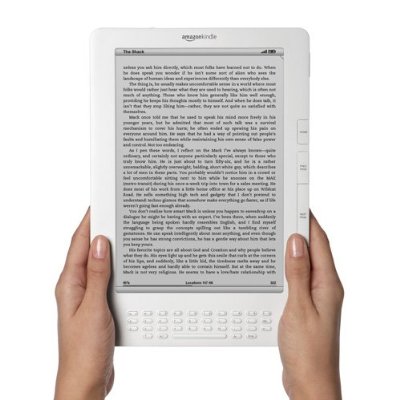
The Amazon Kindle was released in the United States in November of 2007, and it continued to fly off of store shelves and sell like crazy until mid-2008. The idea behind the product is simple: it’s a small, handheld device that can download and display books. With a library of tens of thousands of books, the ability to download materials from almost anywhere in the U.S., and even a few periodicals and blogs thrown in, it’s not difficult to see why consumers gobbled up the Kindle (and its successor, the Kindle 2), even if it is, as one reviewer put it, “yet another dedicated device you'll need to lug around with you.” But what does this have to do with media convergence?
Enter the Kindle DX.
Announced on May 6th, 2009, the Kindle DX is the next big leap forward for Amazon’s e-reader. Rather than consisting of minute and mostly cosmetic updates like the Kindle 2, the Kindle DX features a larger, sharper screen that not only supports books but textbooks, newspapers, and other diverse types of print media.
While many industry experts criticize the Kindle DX for its high price and lack of substantial technological improvements, it is important to consider what this means for the world of media convergence. Will newspapers eventually become revitalized on e-readers, where they can have the large advertising spreads that used to make print journalism so profitable? What about schools – how different will classes be when students can access all of their textbooks from a single hand-held device, rather than paying a fortune at the local bookstore? The Kindle DX may not be a major hardware leap – it still has a grayscale screen and it cannot surf the web – but it has big potential implications for the realm of media convergence. When it becomes available later this year (just in time for the holidays, of course), keep an eye out for what changes it brings… or if it just flops.


No comments:
Post a Comment